

Invisible Crisis: The Growing Shortage of Domestic Workers in Urban Households
“Roz ke sawaalon mein chhupa hai ek bada sawaal—
‘Maid mili?’ ab ban chuka hai har ghar ka haal.”
Across parks, phone calls, and residential societies, this everyday question has become a refrain. What appears routine is, in reality, a signal of a deepening labour market imbalance in urban India.
A Structural Demand–Supply Gap
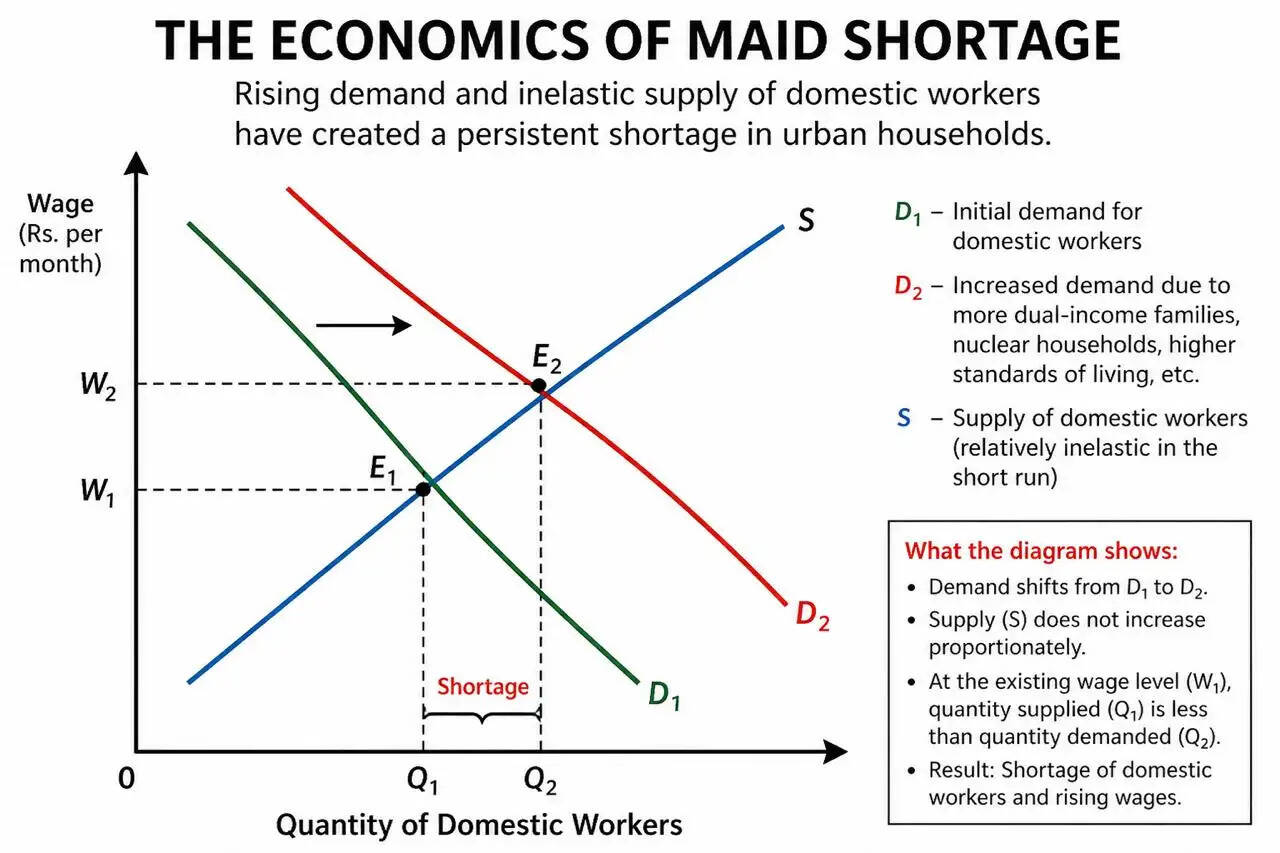
The expansion of dual-income households and the shift toward nuclear families have sharply increased the demand for domestic services—cleaning, cooking, childcare, and elderly care.
However, the supply of domestic workers remains constrained and volatile, influenced by migration patterns, rising urban costs, and the pull of alternative employment opportunities.
In the language of Economics, this reflects a structural demand–supply mismatch, resulting in persistent shortages rather than temporary gaps.
India is estimated to have tens of millions of domestic workers, yet the sector remains largely informal—limiting both stability and efficiency.
Beyond Metros: A Widening Concern
Notably, this shortage is no longer confined to metropolitan cities. Smaller towns and semi-urban areas are increasingly experiencing similar constraints, indicating a broader structural shift in labour availability.
Informality and Labour Market Frictions
The domestic work sector continues to operate largely in the informal economy, characterized by:
* Absence of formal contracts
* Lack of wage standardization
* Limited access to social security
These conditions create labour market frictions—including information gaps and high turnover—reducing the efficiency of matching workers with households.
Changing Labour Supply Behaviour
Domestic workers are increasingly:
* Preferring part-time, multi-household arrangements
* Seeking higher wages and improved working conditions
* Transitioning to alternative employment sectors
This reflects an ongoing occupational shift within the informal labour market, tightening supply in traditional domestic roles.
Household-Level Economic Impact
The shortage has tangible consequences:
* Rising wages for domestic services
* Increased opportunity cost of time for households
* Redistribution of unpaid work, often disproportionately affecting women
These changes directly impact productivity, work–life balance, and female labour force participation.
Macroeconomic Significance
Domestic work plays a crucial role in sustaining urban economies by enabling participation in formal employment sectors. Disruptions in this segment create spillover effects, influencing time allocation, labour productivity, and overall economic efficiency.
⸻
Conclusion
The shortage of domestic workers is not merely a household inconvenience—it is a structural economic challenge rooted in informality, labour mobility, and shifting socio-economic incentives.
A sustainable response requires:
* Formalization of domestic employment
* Establishment of fair wage standards
* Expansion of social security coverage
A national framework for domestic workers—covering registration, minimum wages, and basic protections—can significantly reduce market inefficiencies and restore balance.
Recognizing domestic work as a core urban service sector is essential to ensuring both economic efficiency and the smooth functioning of everyday life.